
- Home equity loans can be refinanced.
- The best home equity loan refinances save more money than they cost.
- Saving money with a refi depends on interest rates, closing costs, and loan terms.
- Comparing rates and fees from several lenders is the best way to save.
So, you used a home equity loan to tackle a big goal — maybe to consolidate debt, fund home improvements, or make a down payment on a second home. That was a smart move, since leveraging your home’s value to borrow money can save thousands in finance charges.
But now the project’s done and the money’s spent. All that’s left is the monthly payment. The good news is, you still have options. Refinancing a home equity loan could help you pay off debt sooner and pay less interest along the way.
How Does a Home Equity Refinance Work?
A home equity loan refinance replaces your current home equity loan with a new one — usually at a different interest rate, loan term, or both. The new loan pays off the old balance, and you make payments on the new loan going forward.
People typically refinance to secure a lower rate, reduce monthly payments, or change the loan term. Some also use refinancing to consolidate other debts — like credit cards or personal loans — into a single, lower-rate payment.
How Often Can You Refinance a Home Equity Loan?
You can refinance a home equity loan any time a lender approves you — but that doesn’t mean you always should. Refinancing costs money upfront in the form of closing costs, including appraisal, lender, and legal fees. The savings from a refinance accumulate gradually over time, so it only makes sense if you’ll keep the loan long enough to recoup those costs.
Benefits of Refinancing a Home Equity Loan
Most homeowners refinance a home equity loan to save money, but there are other potential benefits as well:
- Access more cash: If your home has appreciated or you’ve paid down a significant portion of your balance, you may be able to borrow more than you currently owe and receive the difference as cash at closing.
- Remove a co-borrower: Refinancing pays off the current loan and severs your financial connection to the co-borrower. If you now qualify on your own, the new loan won’t require one.
Here are the main ways a home equity loan refinance can save you money:
1. Lowering the Monthly Payment
Borrowers can lower monthly payments by refinancing to a longer term or locking in a lower rate. Here’s how payments compare on a $50,000 home equity loan across different terms and rates:
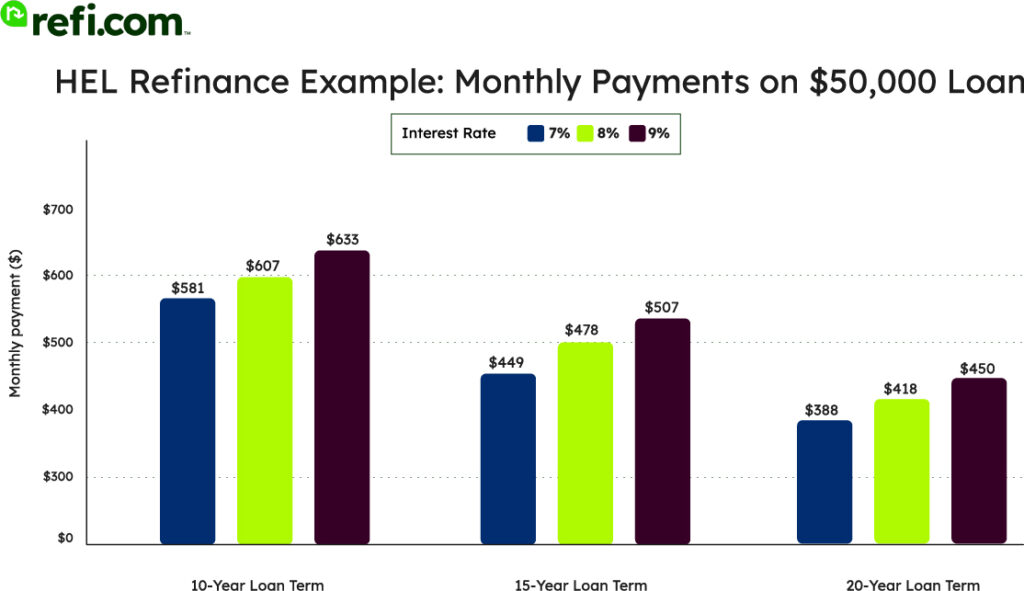
| Interest rate* | 10-year term payment | 15-year term payment | 20-year term payment |
| 7% | $581 | $449 | $388 |
| 8% | $607 | $478 | $418 |
| 9% | $633 | $507 | $450 |
Keep in mind: while a longer term lowers monthly payments, it increases the total interest paid over the life of the loan.
2. Reducing Total Lifetime Interest
A lower interest rate — even with the same term — can significantly reduce the total interest paid. Here’s the lifetime interest on a $50,000 loan across different scenarios:
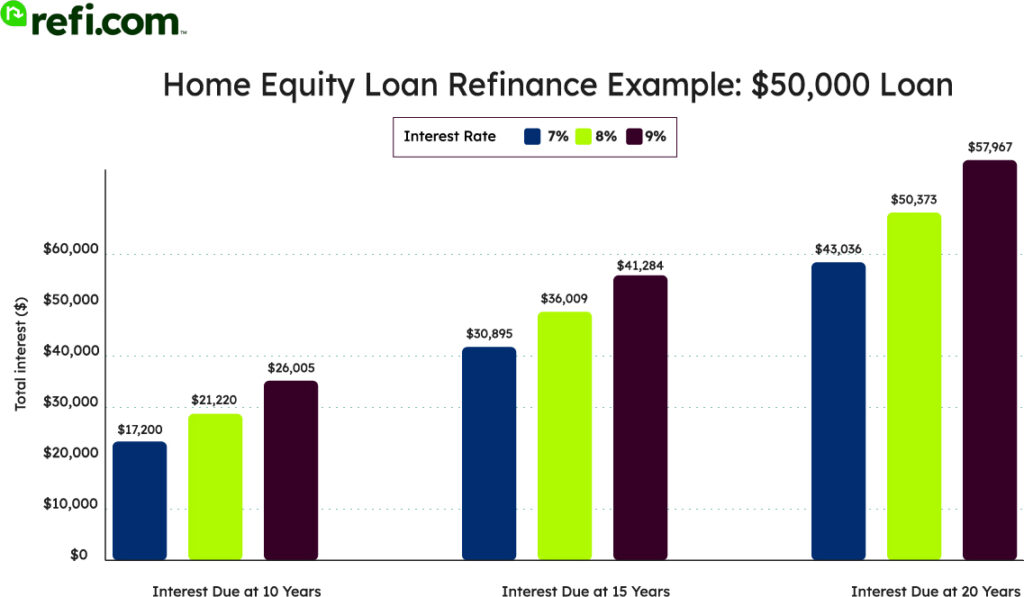
| Interest rate* | 10-year total interest | 15-year total interest | 20-year total interest |
| 7% | $17,200 | $30,895 | $43,036 |
| 8% | $21,220 | $36,009 | $50,373 |
| 9% | $26,005 | $41,284 | $57,967 |
Borrowers can also reduce total interest by paying off the loan early — assuming there’s no prepayment penalty.
3. Consolidating Other Debt
Home equity loans typically carry lower rates than credit cards or personal loans, making them a useful tool for debt consolidation. Rolling high-interest debt into a lower-rate home equity loan simplifies repayment and can reduce total interest significantly.
For example: if you have a $25,000 home equity loan at 9% and $10,000 in credit card balances at 20%, you might be paying over $700 per month combined. Refinancing into a new $35,000 home equity loan at 7% over 15 years could bring that payment down to around $315 — nearly cutting it in half.
Cons of Refinancing a Home Equity Loan
1. Closing Costs
Closing costs typically range from 3% to 6% of the loan amount — meaning a $50,000 refinance could cost $1,500 to $3,000 upfront. You can roll these costs into the loan, but that means paying interest on them for years. Some fees, such as origination and processing fees, may be negotiable.
2. Resetting the Loan Term
Refinancing often restarts your loan term. Even if you secure a lower rate, stretching out repayment over a longer period increases the total interest paid — potentially costing more in the long run despite a lower monthly payment.
3. Risk of Foreclosure
Your home remains collateral for any home equity loan. If you consolidate multiple debts into a single larger mortgage and then default, you put your home at greater risk than if those obligations were separate.
How to Qualify for a Home Equity Loan Refinance
To refinance, both you and your home need to qualify for the new loan.
Home Equity Requirements
Your ability to refinance depends largely on your current equity position. If your home’s value has increased and you’ve been making payments — reducing the loan balance — you likely have enough equity to qualify.
How to Calculate Your CLTV (Combined Loan-to-Value)
- Find your home’s current value using recent comparable sales, an online estimator, or a professional appraisal.
- Add up all mortgage balances — your primary mortgage plus any home equity loan or HELOC balances.
- Calculate your CLTV by dividing your combined mortgage debt by your home’s value, then multiplying by 100.
Example: Home value: $400,000 | Primary mortgage: $200,000 | Home equity loan: $50,000
Combined debt: $250,000 ÷ $400,000 = 0.625 × 100 = 62.5% CLTV
Most lenders won’t approve a loan that would push your CLTV above 85%.
Borrower Eligibility Requirements
Beyond equity, you’ll need to meet standard borrower requirements:
- Credit score: Home equity lenders often require scores of 680 or higher. Scores above 720 typically qualify for the best rates.
- Debt-to-income ratio: Lenders review your DTI to confirm you can handle the new payment. Most prefer a DTI of 43% or lower.
Should You Refinance Your Home Equity Loan?
A refinance only makes financial sense when the savings outweigh the costs. Before moving forward, ask yourself:
How long do you need to keep the loan to break even? If closing costs are $3,000 and you save $100 per month, it takes 30 months to recoup those costs. Use our break-even calculator to model your specific scenario.
Is there a prepayment penalty on your current loan? If so, factor that into your cost analysis — it reduces the effective savings from refinancing.
How much interest remains on your current loan? Check your statement to see how much lifetime interest you’ve already paid. If you’re well into repayment, you may have already paid the bulk of your interest — making a refinance less beneficial than it appears.
Alternatives to a Home Equity Loan Refinance
Cash-Out Refinance
Cash-out refinancing combines multiple mortgages into one larger loan while generating cash back. For example, a $50,000 home equity loan and $150,000 primary mortgage could be consolidated into a single $200,000 loan — plus additional cash if you have enough equity. The tradeoff is higher closing costs on the larger loan amount.
HELOC
A HELOC (home equity line of credit) lets you transfer your home equity loan balance to a revolving line of credit. You only pay interest on what you draw, and you can reuse the line as you pay it down during the draw period (typically 10 years). The downside is a variable interest rate that can increase with market conditions.
Primary Mortgage Refinance
You can roll your home equity loan into your primary mortgage refinance, combining two payments into one. Unlike a cash-out refi, no additional cash is generated — but a single, consolidated payment may be more manageable. This works best when the new loan improves your position on both existing loans.
You can also refinance just your primary mortgage and keep your home equity loan intact. The home equity lender would need to accept second lien position behind the new primary mortgage — which most are willing to do.
Pay Extra on Principal
If you want to pay off the loan faster without refinancing costs, simply make extra payments toward principal. On a 20-year, $50,000 home equity loan at 8%, adding just $100 per month to your payment could pay off the loan 7 years early and save nearly $20,000 in interest. Make sure your lender applies the extra amount to principal, not future payments.
Reverse Mortgage
Homeowners 62 and older can use a reverse mortgage to pay off a home equity loan, provided the home has little or no remaining primary mortgage balance. No monthly payments are required, but interest accrues and the balance must be repaid when the home is sold or the homeowner passes away.
Home Equity Investment (HEI)
An HEI lets an investor purchase a stake in your home’s equity in exchange for a lump-sum payment. You can use that cash to pay off the home equity loan with no monthly payments — but the investor shares in any future appreciation when you sell.
Home Sale
Selling the home is always an option for paying off mortgage balances in full. If you’re already considering downsizing or relocating, it may be the most straightforward path. Otherwise, it’s likely not the right solution.
What to Do Next
The best way to find a good home equity loan refinance is the same as shopping for anything else: compare products and prices. Get quotes from multiple lenders, compare rates and closing costs side by side, and use our break-even calculator to confirm the numbers make sense.
Ready to explore your options? Start your home equity application with Refi.com today.