
That home equity you’ve built can be a powerful asset when you need extra cash. Fortunately, you can tap into it in multiple ways, including a cash-out refinance or a home equity line of credit (HELOC). In this guide, we explain how cash-out refinances and HELOCs work; compare costs, rates, and requirements; and help you decide which option best fits your financial goals.
Key Takeaways:
- A cash-out refinance loan lets you take out a new mortgage that exceeds the amount you currently owe, giving you the difference in cash.
- A HELOC is a second mortgage that lets you borrow against your home’s equity up to a certain limit, with the option to withdraw and repay funds as needed.
- Cash-out refinances are often better for bigger financial needs or for those who want to adjust their mortgage terms. HELOCs are often better for smaller, variable, or ongoing needs.
A Quick Refresher on Home Equity
Home equity is the difference between your home’s market value and the balance of your outstanding mortgage. It’s essentially the amount of your property’s worth that you own outright and could pocket today if you sold your home. You earn equity through:
- The down payment
- The principal portion of your monthly mortgage payments
- Home appreciation over time (if your home appreciates)
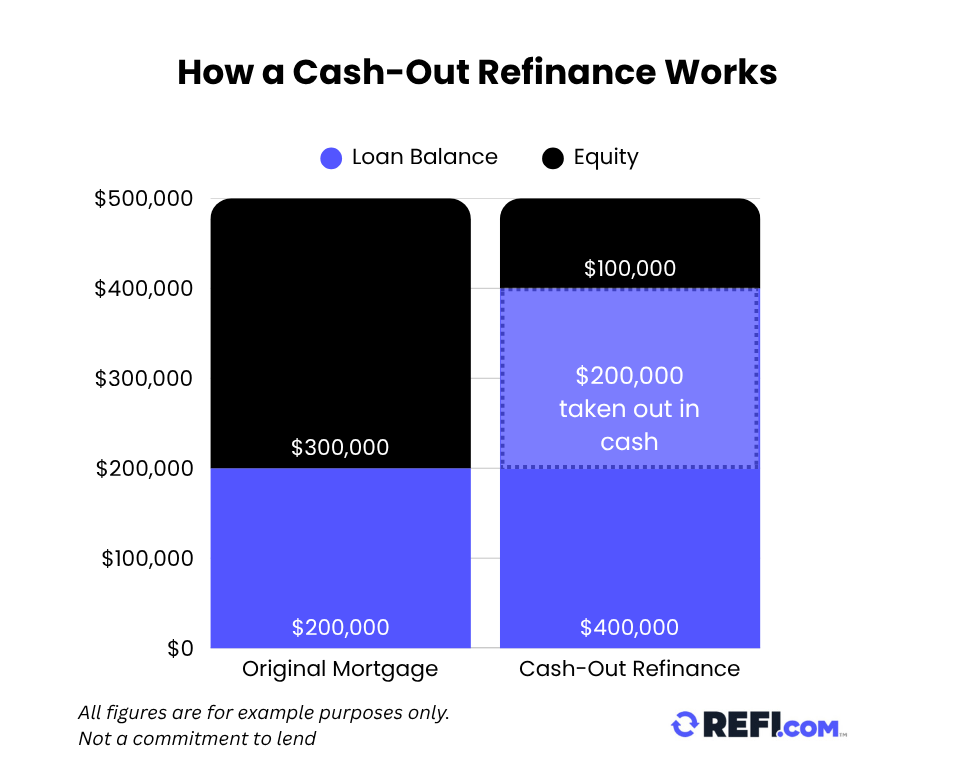
For example, if you own a $500,000 home and you still owe $200,000 on your mortgage loan, you have $300,000 in equity. That means you own 60% of your home’s value.
There are plenty of good reasons for liquidating home equity. The most common uses for home equity include:
- Funding home improvement projects
- Consolidating debt
- Investing in a business
- Paying for major life expenses like a college education
- Making another large purchase, like a second home
There are a few ways you can tap into your home equity: a home equity loan, a home equity line of credit (HELOC), or a cash-out refinance loan. The latter two are the most popular options among homeowners because they typically offer lower interest rates than personal loans and provide flexible access to funds for major expenses like home improvements or debt consolidation.
What Is a Cash-Out Refinance?
A cash-out refinance is like getting a new mortgage, but with a twist: you refinance and replace your existing mortgage loan for more than what you currently owe, taking out the difference as cash at closing. You use your home as collateral for the loan, which means you risk losing your property to foreclosure if you don’t repay your debt as agreed upon.
Because a cash-out refinance increases your total loan amount, it also increases your loan-to-value (LTV) ratio. If you have a high LTV and your home declines in value, you also risk having negative equity, known as being underwater on your mortgage.
A cash-out refinance can be a good fit if:
- You’ve built up significant equity.
- You need a larger lump sum of money.
- You want to consolidate higher-interest debt.
- You plan a major renovation or large purchase.
- You can secure a competitive rate on the new mortgage compared with your current one.
Many lenders prefer that you have at least 20% equity remaining after the refinance. That helps keep your LTV at a level they consider lower risk.
Cash-Out Refinance Example:
- Home value: $500,000
- Current mortgage balance: $200,000
- Current equity: $300,000
A homeowner might refinance into a $400,000 mortgage, taking $200,000 in cash and retaining 20% equity ($100,000). They now have a higher mortgage balance but also access to funds to use for renovations, debt payoff, or other major expenses.
What Is a HELOC?
A home equity line of credit (HELOC), on the other hand, works more like a credit card than a traditional loan. It’s a revolving line of credit secured by the home equity you have in your home.
A HELOC works by approving you for a maximum credit limit based on factors such as your home value, income, credit score, and overall financial profile. You can then borrow from this line of credit as needed during the draw period, which typically lasts between three and ten years. During this phase, many HELOCs only require interest payments on the amount you’ve actually borrowed, keeping monthly costs relatively low.
Once the draw period ends, the HELOC transitions to the repayment period, which often lasts 10 to 20 years. During this time, you can no longer borrow additional funds and must repay both principal and interest. This usually results in higher monthly payments than those required during the draw period.
A HELOC can be a good fit if:
- You want flexible, ongoing access to funds over several years.
- Your expenses will happen over time, such as phased home renovations or education costs.
- You prefer not to replace your existing first mortgage.
- You’re comfortable with a variable interest rate and payment changes.
Cash-Out Refinance vs. HELOC: Key Differences
| Feature | Cash-Out Refinance | HELOC |
| What It Is | A new, larger first mortgage that replaces your existing loan; you receive the difference as a lump sum | A revolving line of credit secured by your home; you borrow as needed up to a set limit |
| Loan Structure | New first mortgage | Second mortgage (usually) |
| Interest Rate | Often fixed (but can be adjustable); predictable payment if fixed | Usually variable (some fixed-rate options); payment can change over time |
| Monthly Payments | One principal-and-interest payment on the new mortgage | Interest-only during draw period; principal + interest during repayment period |
| Access to Money | Single lump sum at closing | Access funds as needed during the draw period |
| Closing Costs | Typically higher, around 2%–5% of the loan amount | Often lower; some lenders offer low or no closing costs but may charge ongoing fees |
| Typical LTV/CLTV Limits | Often up to 80% of your home’s value (higher for certain VA loans) | Often up to 80%–85% combined loan-to-value (CLTV) |
| Best For | Large, one-time expenses, debt consolidation, or changing your mortgage rate/term | Ongoing or unpredictable expenses, phased projects, or when you want to keep your existing first-mortgage rate |
| Key Risks | Higher mortgage balance, possible higher rate, and longer payoff timeline | Variable-rate risk and potentially higher payments in the future |
Cash-Out Refinance vs. HELOC Rates
Cash-out refinance rates can be fixed or adjustable, but many homeowners choose fixed rates for stability. Your rate depends on your credit score, program type, and market conditions. Rates can vary widely from lender to lender and based on loan type; you could be charged a higher rate for a conventional versus an FHA, VA, or USDA loan, for instance. Because you refinance the entire mortgage and not just the accessed equity, your monthly payment might change significantly.
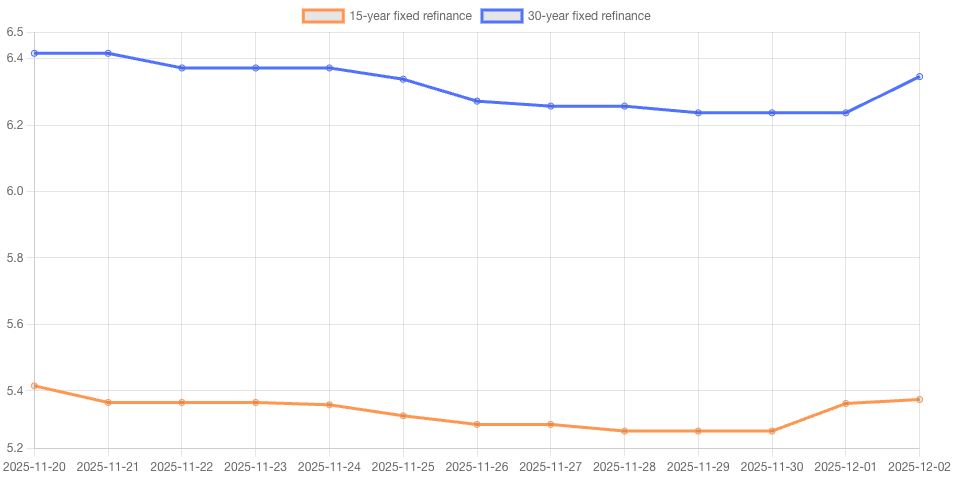
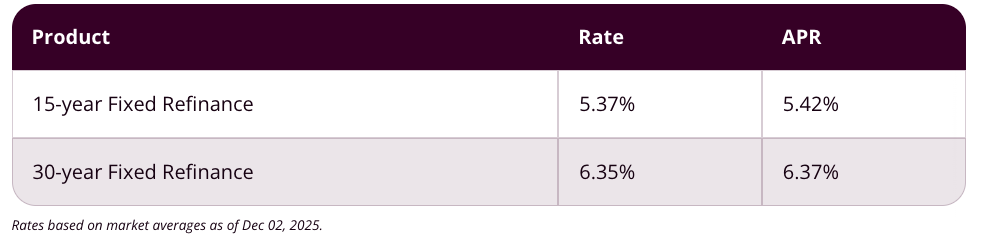
How we source rates and rate trends
HELOC rates are typically variable, meaning your payment can fluctuate over time. This structure can make a HELOC initially more affordable, especially during interest-only payments, but borrowers should prepare for higher payments if rates rise or when principal repayment starts.
Cash-Out Refinance vs. HELOC Requirements
Cash-out refinances and HELOCs can have similar requirements, though these vary by lender. Even in cases where government-backed programs have minimum/maximum requirements, lenders often impose their own, stricter requirements.
Lenders oftentimes take compensating factors into consideration as well.
Despite the possible variance, here’s what you may expect regarding eligibility:
Credit Score
For a cash-out refinance, aim to have a minimum credit score of 660, although a score of 700 or higher could secure better terms. Some lenders may go as low as 620, which is the minimum required by Fannie Mae and Freddie Mac. Here’s a breakdown of the minimum credit score typically needed by loan type:
- Conventional cash-out refi: 620
- Refi.com requires a minimum 660 FICO credit score for a conventional cash-out refinance.
- FHA cash-out refi: 500-620
- Refi.com requires a minimum 620 FICO credit score for an FHA cash-out.
- VA cash-out refi: The VA does not set a minimum credit score, but 620 is a common requirement.
HELOCs have very similar credit score requirements, with lenders often requiring between 620 and 700+.
Debt-to-Income Ratio
Your debt-to-income (DTI) ratio measures your ability to manage debt, expressed as a percentage of your gross monthly income. Most lenders look at your back-end DTI ratio, which accounts for all debts (as opposed to your front-end DTI, which only considers housing expenses).
For example, if:
- Your gross monthly income is $5,000
- Your housing payment is $1,200
- Your other debts total $600 per month
Then, your back-end DTI is: $1,800 ÷ $5,000 = 36%
Lenders use this ratio to determine how much additional debt a borrower can handle. Lower ratios often result in better loan terms.
Many cash-out refinance lenders prefer a DTI ratio of 50% or lower.
Here are common DTI requirements based on loan type:
- Conventional cash-out refi: 36% to 43%
- FHA cash-out refi: Up to 50%
- VA cash-out refi: While the VA doesn’t cap DTI, most lenders prefer it at or below 50%, unless the borrower meets residual income guidelines and other compensating factors.
Lender-specific guidelines may impose stricter DTI limits. Compensating factors can also impact approval, sometimes allowing for higher DTI ratios.
HELOCs require a similar DTI range, with many lenders requiring no more than 43%, though some may go as high as 50%. This can vary widely, and lenders may consider additional compensating factors.
Loan-to-Value Ratio
In a cash-out refinance, your loan-to-value (LTV) ratio determines how much of your home’s appraised value you can borrow; typically up to 80%.
For example, if:
- Your home is worth $300,000
- You owe $150,000 on your current mortgage
Many lenders will allow a cash-out refinance up to 80% LTV:
- 80% of $300,000 = $240,000 maximum new loan amount
- After paying off the $150,000 existing mortgage balance, you could receive up to $90,000 cash out (before closing costs).
Here are the maximum LTVs allowed for a cash-out refinance based on loan type:
- Conventional cash-out refi: Up to 80% of the home’s appraised value
- FHA cash-out refi: Up to 80% of the home’s appraised value
- VA cash-out refi: Up to 100% of the home’s appraised value, though many lenders cap it at 90%
Lender-specific guidelines may impose stricter LTV limits.
For HELOCs, most lenders want you to keep your LTV at 85% or lower, meaning you should have at least 15% equity built up in your home. However, some lenders require an LTV of no more than 80%.
Closing Costs
Regardless of whether you opt for a conventional, FHA, or VA cash-out refinance loan, you will be charged closing costs. These typically equate to 2% to 5% of your total loan amount. Common closing costs include:
- Loan origination fee: Generally ranges from 0.5% to 1% of the loan amount
- Title search and title insurance: Usually costs between $500 and $1,000
- Appraisal fee: Typically between $300 and $600
- Escrow fees: Often ranging from $200 to $500, depending on location
- Credit report fee: Usually $30 to $50
- Recording fees: Generally between $50 and $150
You could also be charged additional fees depending on the loan type, including:
- FHA cash-out refi: Upfront mortgage insurance premium (UFMIP) of 1.75% of your loan amount
- VA cash-out refi: Funding fee of 1.4% to 3.6% of the loan amount, depending on your service status and whether it’s a first or subsequent use of VA benefits
HELOC closing costs average 2% to 5% of your credit line/borrowed amount. However, some lenders charge minimal to no closing costs. HELOCs can also come with ongoing costs, such as annual fees, transaction fees, and early closure fees.
How You Access Your Money
With a cash-out refinance loan, you receive your tapped equity right away in a lump sum. After closing, the cash-out portion is typically disbursed via wire transfer or check and can usually be accessed within 3 to 5 days.
With a HELOC, you can access funds during the HELOC’s draw period, which is typically 10 years, but can range from 3 to 15 years. To do so, you can use online transfers, checks, or a credit card provided by the lender.
Tax Considerations
Interest on both cash-out refinances and HELOCs is typically only tax-deductible if used to buy, build, or substantially improve your primary or second home, in accordance with IRS rules.
Additionally, the money you receive is not taxable, as it’s a loan and not considered income.
What’s the Best Option for You?
“For smaller or temporary needs, a HELOC is often best,” advises Lauryn Grayes, founder of Wealth Gems Financial Solutions. “For bigger needs at a good rate, a cash-out refinance loan can save you more money in the long term. However, be cautious when tapping your equity, as it reduces your ownership stake and is risky if home values decline. Consider your needs, timeline, credit rating, and amount of home equity accrued to choose the right option.”
A cash-out refi may be best for those looking to lower their mortgage interest rate while also accessing a large lump sum. It’s ideal when you can get a good interest rate on your new mortgage and need funds for a specific, large expense.
A HELOC, meanwhile, is best for homeowners who need flexible access to funds over time, such as for ongoing home renovations. It’s also beneficial if you don’t want to change your lower existing mortgage rate or reset your term, which can add extra years to your mortgage repayment schedule.
If you seek to consolidate debt, a cash-out refi is likely the better choice.
For instance, homeowners with low existing mortgage rates might avoid refinancing into a higher-rate cash-out loan and instead opt for a HELOC. Conversely, borrowers with high-interest credit card balances could save a lot by rolling that debt into a cash-out refinance, even if it means a slightly higher mortgage rate.
Because borrowing against your home carries risk, consider speaking with a financial advisor or lending specialist who can help you evaluate your goals. If you’re ready to explore your options, Refi.com can help you get started.